

How to Read a Snack Label in 10 Seconds
Share
I've been turning packages over in grocery aisles since before it was fashionable, and I've watched the front of the box get louder every year while the back stays exactly as honest as it always was.
You don't need to know much. You need to know where to look and in what order. Here's mine.
1. The first ingredient
Ingredients are listed by weight, most to least. Whatever is first is what you're mostly eating.
If a snack is sold to you as a protein food and the first word isn't a protein, you've learned everything you need to and you can put it back. That one check catches more nonsense than any other.
And read how it's described. "Beef" and "100% grass-fed beef" are different sentences. A brand proud of its sourcing says so on the ingredient line, not just the front.
2. How many ingredients there are
Not a rule, just a signal. Count them, and see how many you can pronounce.
Long lists aren't automatically bad — some of those words are vitamins. But a long list on something simple, like dried meat, means work was done to it that didn't need doing.
3. Added sugars
This is the most useful line on any modern label, and it's fairly new. It sits underneath Total Sugars and it tells you how much sugar was put in, as opposed to what was already in the fruit or the milk.
That distinction matters. A yogurt with 12 grams of total sugar and 0 added is a different food from one with 12 grams and 10 added.
This is the number the front of the box works hardest to distract you from. "Made with real fruit." "No high fructose corn syrup." "Naturally sweetened." All of those can sit on a package carrying twelve grams of added sugar.
4. Sodium, if it applies to you
For most snacks this is the one nobody checks and probably should. Anything cured, brined or crunchy-salty carries real salt.
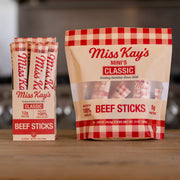
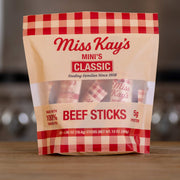
I'll go first: our full-size stick is 730 milligrams. The mini is 300. For scale, the Dietary Guidelines say under 2,300 a day from age 14, and under 1,500 for children 4 to 8. If you're minding sodium, that's a number you deserve to have before you buy, not after.
The four things the front of a box does
Every one of these is legal, common, and designed to stop you flipping it over.
- Claiming an absence. "No high fructose corn syrup" often means it has a different syrup instead.
- Borrowing a health word. "Natural" is barely regulated. "Made with whole grains" doesn't tell you how much.
- Shrinking the serving. Impressive numbers get much less impressive when you notice the bag is two and a half servings.
- Putting a child on it. A cartoon on a package is a marketing decision, not a nutrition one.
The whole thing in one move
Turn it over. First ingredient, how many ingredients, added sugars, sodium. Ten seconds, four numbers, and you know more about that snack than the front of the box wanted you to. Here's how I use it to fill a lunchbox.
Do it to mine too. Seven ingredients: 100% grass-fed beef, water, coconut sugar, sea salt, citric acid, spices, celery juice powder. Two grams of sugar in the full-size, from the coconut sugar, and it's on the label where you can find it.
We won't print "sugar-free" on a box, because coconut sugar is still sugar. If I'm asking you to read labels, mine had better hold up to it.
— Miss Kay