
Read the label
How to Compare Beef Sticks: Grass-Fed, Sugar, Sodium, Casing
Every beef stick on the shelf says something nice on the front. The back is where you compare them. Here's how I'd line up any two sticks, mine included, in about a minute. No brand names, just the label.
First, compare the same amount
Sticks don't all weigh the same. A typical stick is about an ounce. Our Classic is 1.5 ounces and our Mini is 0.65. So before you compare protein, sugar or salt, look at the serving size at the top of the panel and compare per ounce.
It's easy math: divide the number by the ounces. Our Classic has 730mg of sodium in 1.5 ounces, which is about 487mg an ounce. The Mini has 300mg in 0.65 ounces, about 462mg an ounce. Same recipe, nearly the same salt per bite, just a smaller stick.
Grass-fed: read the whole claim
Under USDA's labeling guideline, "grass-fed" or "100% grass-fed" on a meat label is meant for cattle that ate only forage, like grass and hay, after they were weaned. If the animals also ate grain, the claim is supposed to say so, for example "fed 85% grass and 15% corn."
So read the claim word for word, and read the ingredient line, not just the front. USDA also encourages third-party certification for claims like this, so a certifier's name near the claim is a good sign. Ours says "100% grass-fed beef," first on the ingredient list. (More on grass-fed and grain-finished beef.)
Sugar: the Added Sugars line and the ingredient list
The Nutrition Facts panel has an Added Sugars line that counts sugar put in during making, syrups and honey included. On a meat stick, that's the number to compare.
Then read the ingredient list for the sweetener's name. Cane sugar, brown sugar, honey, maple syrup, corn syrup, dextrose and fruit juice concentrate are all sugar. A stick with no refined sugar can still contain sugar, so check the panel either way.
Here's mine: two grams of coconut sugar in a full-size Classic. The Minis are the same recipe; coconut sugar is on their label too, there's just so little per stick that the panel rounds to 0g. No refined sugar in either.
Sodium: compare it to the day, not just the stick
Every cured meat carries salt; that's part of what keeps it on a shelf. The number to watch is milligrams of sodium, and the fair comparison is against the whole day.
The 2025-2030 Dietary Guidelines put the daily limit at under 2,300mg for anyone 14 and older, under 1,800mg for ages 9 to 13, under 1,500mg for ages 4 to 8, and under 1,200mg for ages 1 to 3.
I'll go first. Our Classic has 730mg a stick. The Mini has 300mg, less because it's a smaller stick; per ounce they're about the same.
Casing: what holds it together
A meat stick is stuffed into a casing, and a collagen casing has to be disclosed on the label. Here's the part worth knowing: when the casing comes from a different animal than the meat inside, USDA requires the label to say so, such as "in a sheep collagen casing." A casing from the same animal as the meat doesn't have to be named, so if it only says "collagen casing," the source isn't named. If your family avoids pork or any other meat, the casing line is the one to read.
Ours is a beef collagen casing, the same animal as the meat. It's edible, and it's what gives the stick its snap.
Two more quick checks
- The first ingredient. On a meat label, ingredients are listed from most to least. On a beef stick, the first one should say what kind of beef.
- How many ingredients. Count them. Ours is seven: 100% grass-fed beef, water, coconut sugar, sea salt, citric acid, spices and celery juice powder. Here's why each one is there, including the celery juice powder that cures it.
Line mine up against any stick you like. That's what the label is for.
Nothing I wouldn't feed my own grandkids.
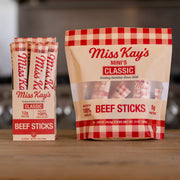
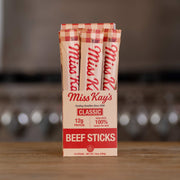
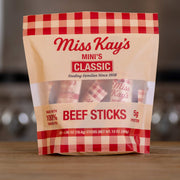
Our label, for comparing
Straight off our label, per stick.
| Per stick | Classic (1.5oz) | Mini (0.65oz) |
|---|---|---|
| Beef | 100% grass-fed | 100% grass-fed |
| Sugar | 2g, from coconut sugar | Rounds to 0g (contains coconut sugar) |
| Sodium | 730mg | 300mg |
| Sodium per ounce | About 487mg | About 462mg |
| Casing | Beef collagen | Beef collagen |
| Ingredients | 7 | 7 |
Compare for yourself
Put ours next to yours
The same seven ingredients in both sizes. The full label is on every product page.


Good to know
Questions about comparing beef sticks
What does 100% grass-fed mean on a beef stick label?
Under USDA's labeling guideline, a grass-fed claim on meat is meant for cattle that ate only forage, like grass and hay, after weaning. If the animals also ate grain, the claim should say how much. Read the claim word for word and check the ingredient line.
How much sodium is in a beef stick?
It varies by brand and size, so check the panel and compare per ounce. Ours: 730mg in a 1.5-ounce Classic and 300mg in a 0.65-ounce Mini. The 2025-2030 Dietary Guidelines' daily limit is under 1,500mg for ages 4 to 8 and under 2,300mg from age 14.
Do beef sticks have sugar in them?
Some do, so read the Added Sugars line and the ingredient list. Ours has two grams of coconut sugar in a full-size Classic; the Minis are the same recipe, and the panel rounds to 0g per stick. No refined sugar in either.
What is a beef stick casing made of?
It depends on the stick, so read the label. When a collagen casing comes from a different animal than the meat, USDA requires the label to say so. Ours is a beef collagen casing.
How do I compare beef sticks of different sizes?
Use the serving size at the top of the panel and compare per ounce: divide the protein, sugar or sodium by the stick's weight in ounces.
From my kitchen
No hype, just the label.
A note now and then, and first word on anything new.