

Beef Sticks vs Beef Jerky: What's Actually Different
Share
Folks ask me this at least once a week, usually while standing in front of a gas station rack trying to decide. So let me save you the squinting.
A beef stick and a piece of beef jerky are not the same food wearing different clothes. They're made two different ways, and that one difference explains almost everything else about them.
The short answer
Jerky is a slice of whole muscle meat that's been marinated and dried. You're eating a piece of a steak, essentially, with the water pulled out of it.
A beef stick is ground beef that's been seasoned, stuffed into a casing, and cured. Closer to a sausage than a steak. That's why it's soft enough to bite through without a fight.
Why the texture is different
Because jerky is whole muscle with the moisture removed, it stays chewy. Some brands lean into that; a few are downright tough. That's the appeal for a lot of people, and I'm not knocking it.
A stick is minced and formed, so it gives easily. That matters more than people expect. If you've ever handed a five-year-old a piece of jerky and watched them gnaw on it for two minutes before giving up and putting it back in the bag, you know exactly what I mean. Softer means it actually gets eaten.
Protein, fat and sodium
Here's where I'll be straight with you, because the honest answer isn't the one that flatters me.
Jerky usually wins on protein per calorie. It's lean muscle with the water gone, so you get a lot of protein in a small package and not much fat. If protein per bite is the only number you care about, jerky is often the better buy.
Sticks carry more fat, because they're made from ground beef and fat is part of what holds a stick together and makes it taste like something. Our full-size Classic has 9 grams, alongside 12 grams of protein.
Sodium is a coin flip, and it varies more between brands than it does between the two formats. Both are cured, and curing means salt. Check the panel on whichever one you're holding rather than assuming.
The sugar nobody mentions
This is the one I'd actually pay attention to, and it applies to both.
A lot of jerky is sweet. Teriyaki, honey, barbecue, maple — those marinades carry real sugar, and it's not unusual to find six grams in a one-ounce serving (here's one national teriyaki jerky's label). Sticks tend to run lower, but plenty of them have sugar too.
Turn the package over and find the line that says Added Sugars (here's how I read a label). It's its own row now, and it's the honest one. That single number tells you more about what you're holding than anything printed on the front.
Ours has 2 grams in the full-size Classic, from coconut sugar. The minis are the same recipe; there's just so little per stick that the panel rounds to 0g. We won't print "sugar-free" on a box, because coconut sugar is still sugar — but we'll tell you the number without you having to hunt for it.
Which one should you buy?
Get jerky if you want the most protein for the fewest calories, you like something to chew on, and you're buying for adults.
Get sticks if it's going in a lunchbox, if it's for a child, or if you want something you can eat one-handed while driving.
Most families I know keep both around and don't think about it much harder than that.
What to check on either one
- Ingredient count. Seven is easy to read. A long list on something as simple as dried meat is worth a second look, whichever format it is.
- Added sugars. Its own line on the panel. Sweet-flavored anything will surprise you.
- What the meat is. "Beef" tells you less than "100% grass-fed beef." If a brand is proud of its sourcing, it'll say so plainly.
- Sodium, if you're minding it. Both formats are cured, so both carry salt.
What's in ours
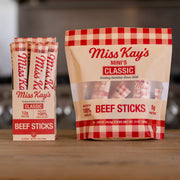
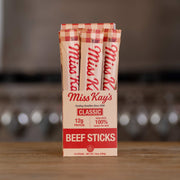
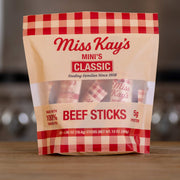
Seven ingredients: 100% grass-fed beef, water, coconut sugar, sea salt, citric acid, spices, and celery juice powder, in a beef collagen casing. Twelve grams of protein in the full-size stick, five in the mini.
They're sticks, not jerky: the minis are sized for lunchboxes, and neither size needs a cooler pack to survive a school morning. That was the whole point.
Nothing I wouldn't feed my own grandkids.
— Miss Kay