

Are Beef Sticks a Good Snack? An Honest Answer
Share
I get asked this a lot, and folks usually want a yes or a no. I can't give you one honestly, so I'll give you something more useful instead: how to tell.
"Beef stick" describes a shape, not a recipe. There are sticks made of grass-fed beef and salt, and there are sticks made of mechanically separated meat, corn syrup, and a list of things you'd need a chemistry degree to sound out. Same shape. Nothing else in common.
What sticks are genuinely good at
Protein in a small package. A full-size stick like ours carries 12 grams. That's real food doing real work in a lunchbox or a purse.
No refrigeration. This is the underrated one. A snack that survives a warm backpack from seven in the morning until noon is a snack that actually gets eaten.
Portion control built in. One stick is one serving. There's no bottom of the bag to hit.
Where they fall short, mine included
Sodium. This is the honest weak spot for every cured meat, and I'd rather say it out loud than have you discover it. Ours is 730 milligrams in a full-size stick, 300 in a mini. If you're watching sodium, that's a real number and you should weigh it against the daily limit in the Dietary Guidelines: under 2,300 milligrams for anyone 14 and up, under 1,500 for children 4 to 8. The Mini has less per stick because it's a smaller stick; per ounce they're about the same.
Fat. A stick is ground beef, and fat is part of what makes it hold together and taste like something. Nine grams in a full-size. Jerky runs leaner if that's what you're after.
Anybody who tells you their cured meat snack has no downside is selling you something.
The sugar question
Flip the package and find Added Sugars. It's its own line on the panel now, which is the single most useful change to food labels in years.
You'll be surprised. Sweet-flavored sticks and jerky can carry six grams or so (one national teriyaki jerky lists 6 grams an ounce), hiding inside something marketed as protein.
Ours has 2 grams in the full-size Classic, from coconut sugar. The minis are the same recipe; there's just so little per stick that the panel rounds to 0g. We don't print "sugar-free" on the box, because coconut sugar is still sugar and I'm not going to pretend otherwise.
The ingredient list tells you more than the front
The front of a package is advertising. The back is the truth, and the ingredient list is the fastest read on it.
Count the ingredients. A long list on something as simple as dried meat is worth a second look. And look at what's first — that's what there's the most of. If the first word isn't a kind of meat, put it back.
How I'd judge any stick in ten seconds
- First ingredient: is it beef? Does it say what kind?
- Ingredient count: under ten is a good sign.
- Added sugars: the lower the better, and know the number.
- Sodium: compare it against what else you're eating that day.
- Protein: if it's only a gram or two, it's a treat, not a snack that holds anybody over.
So, are they a good snack?
A clean beef stick is a reasonable, filling, shelf-stable source of protein with a meaningful amount of salt in it. That's the accurate description, and it's what I'd tell my own family.
It isn't a vegetable. It isn't a miracle. It's a real-food snack that beats most of what else is sitting at that register, and it beats a granola bar with twelve grams of added sugar and a cartoon on the front by a country mile.
What's in ours
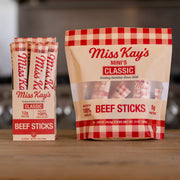
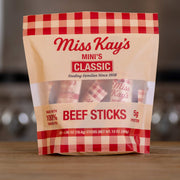
Seven ingredients: 100% grass-fed beef, water, coconut sugar, sea salt, citric acid, spices, celery juice powder. In a beef collagen casing. That's the whole list (here's why each one is in there), and now you know how to read anybody else's.
Nothing I wouldn't feed my own grandkids.
— Miss Kay